

Common questions about pelvic floor training
Frequent visitor questions about Kegel exercises for men, how often to practise, what discomfort means during a session, and when it is worth asking a qualified professional. Educational guidance for men in Indonesia — no promised outcomes, no shortcuts.
How to use this page
Four question groups, one honest answer each
Questions arrive in roughly the same order. First people want to know what they are actually squeezing. Then how often. Then what should feel normal while practising. And finally: what belongs with a qualified professional rather than a web page. Each group below answers one of those, and links onward when a longer guide helps.
Group one and two
Finding the muscle, then setting a rhythm
Most confusion at the start is not about effort. It is about which muscles you are actually using and how much practice a week makes sense before the movement becomes familiar.
How do I know I have found the right muscle?
The pelvic floor sits like a shallow bowl between the tailbone and the front of the pelvis. Try stopping the flow of urine mid-stream once, purely to notice which muscles move — then do not keep doing it, because that habit interferes with normal emptying. Instead, sit or lie still and think of lifting that same area gently inward and upward. If the buttocks, thighs and stomach stay soft, you have probably found the right group. If everything clenches at once, lighten the effort by half.
How often should I do Kegel exercises for men?
A common starting point is two short sessions a day, most days of the week — often described as one in the morning and one in the evening. Keep each hold brief at first, around three to five seconds, with a matching rest between repetitions. Ten repetitions per session is a reasonable beginning. Build slowly over several weeks rather than adding repetitions every day, and take at least one rest day a week so the muscles are not working every single session.
Does a longer hold mean a better session?
No. A hold you can control and release cleanly is worth more than a long hold you finish by gripping your stomach and holding your breath. If you notice the breath stopping, the hold is too long for now. Aim for a comfortable count, rest for the same count, and stop the set while the last repetition still feels steady. Quality of control is the training; duration follows it.
Can I practise while sitting at a desk or commuting?
Yes, and it is one reason the routine survives a busy week. Sitting upright with both feet on the floor and the lower back supported is a fine position for quiet repetitions. In Jakarta traffic, a red light is enough time for a short set. The one place to avoid is the toilet seat, because that habit teaches the muscle to work against a relaxed position it should keep free.
See also: Kegel Basics for Men for the anatomy, and Daily Routine Builder if you want a week laid out for you.
Comfort during practice: steady effort, not strain
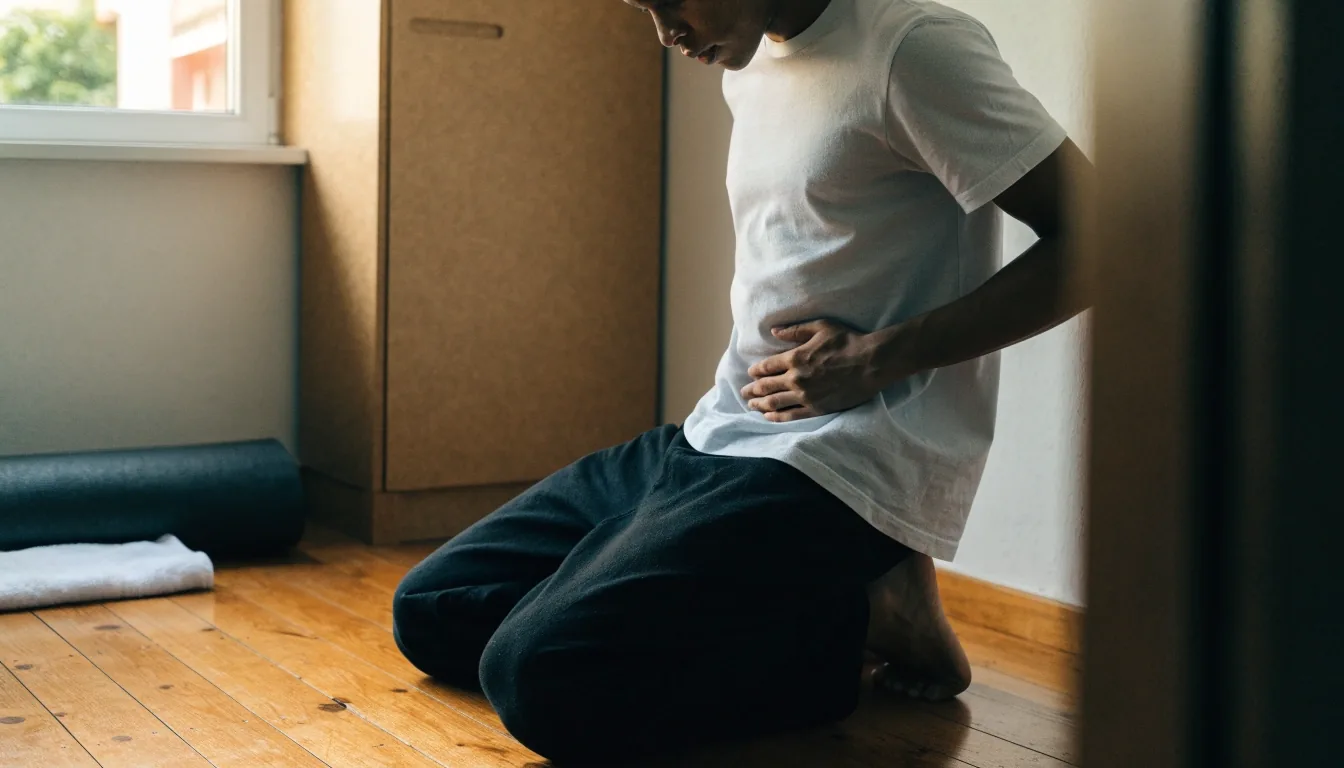
Most questions about comfort come down to one thing: telling the difference between muscles working and muscles complaining. The table below lists what people commonly report during a session and how to read each signal before deciding whether to continue.
During the hold
A quiet, steady lift
You should be able to breathe normally and keep the stomach soft. If the lift fades halfway through, end the repetition there and rest for the same count.
Between sets
Full release, no tugging
Rest for as long as you held. A muscle that never fully lets go between repetitions is being overworked, not trained well.
After the session
Awareness, not soreness
A faint sense of having used the area is normal. Sharp pain, cramping or a heaviness that lingers for days is not a training signal — reduce the effort and ask a qualified professional.
Is it normal to hold my breath while squeezing?
It is common at first, and it usually means the effort is too high. Breathe out slowly as you lift and in as you release. Practising the breath on its own, without the squeeze, for a minute before the set makes it much easier to keep them separate.
What if I feel nothing at all during a session?
Feeling very little is a reason to slow down, not to squeeze harder. Try lying down with the knees bent, where the pelvis is supported and the signal is easier to notice. A hand placed lightly on the lower abdomen helps confirm the stomach is staying soft. If nothing changes after several weeks of careful practice, that is a question worth bringing to a qualified professional rather than pushing through.
Should I practise on days when the area feels tired?
Treat it the way you would any other muscle. If the area feels tired or heavy, take the day off and return when it feels neutral again. Skipping a session costs nothing; practising through persistent fatigue is how people lose the feel for a clean, controlled lift.
See also: Posture, Breathing & Core for the breathing pattern in full.
Group four
When a guide is not the right place to look
An educational page can explain how a muscle works and how often people usually practise. It cannot examine you. The situations below are the ones where a qualified professional is the sensible next step rather than another week of guessing.
Bring it up
Leaking urine during a cough, a sneeze or a lift is common but not something to manage alone indefinitely.
Bring it up
Ongoing pain in the pelvis, lower back or during everyday movement deserves a proper look rather than more repetitions.
Bring it up
No change in the feel of the movement after several weeks of careful, regular practice — the muscle may need a different approach.
Bring it up
Recent pelvic or abdominal surgery, or any period of recovery where you have been told to avoid certain movements.
Bring it up
Difficulty passing urine or opening the bowels, or a feeling of incomplete emptying that has been going on for a while.
Bring it up
Anything that worries you outside this list. A short conversation with someone qualified usually settles the question faster than searching does.
What to bring to that conversation
You do not need a formal referral to ask a question, but a short written note helps. Jot down when the issue started, how often it appears, which movements bring it on, and what you have already tried in your routine. If you have been practising pelvic floor exercises, say how many sessions a week and how long you have kept it up. That detail is what turns a vague description into something a professional can actually work with.
This page is educational material. It is not a substitute for an individual assessment, and it does not promise any result. What it can do is help you describe your situation clearly and know which questions to ask next.
See also: Everyday Self-Care Habits for the routines that sit alongside practice.

Keep reading
Where the rest of the answers live
Each guide on this site covers one part of the routine in more detail. If your question was not here, the contact page is the shortest route to a human reply during working hours.
Questions about the site itself, corrections, or a topic you would like covered can go to [email protected], or call +62 21 584 7721 Monday to Friday, 9:00 AM – 6:00 PM (WIB).
PelvicCore Men's Wellness · Jl. Kemang Raya No. 18, Jakarta Selatan, DKI Jakarta 12730, Indonesia